
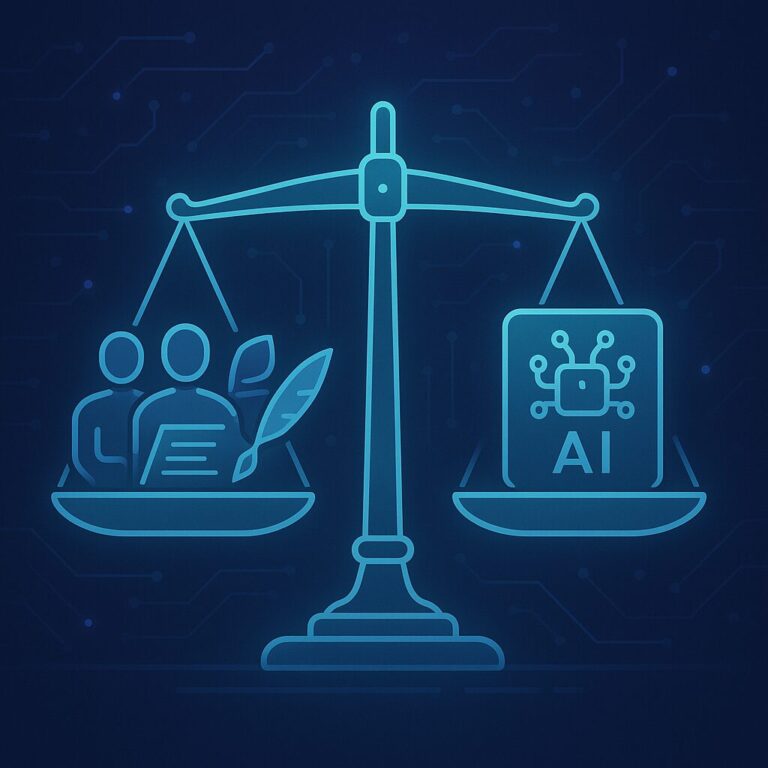
Music Rights
Up to now, Music and art, as human creations, can be protected by copyright law as intellectual property. The owner of those rights can be the writers, composers, and even sometimes the record labels that own them. But also people with a lot of money who buy that music to receive royalties from people who use that protected music.
I’ve been studying copyright law and intellectual property since law school. I even wrote my bachelor’s thesis about the Napster case.
The Napster Case
Napster was one of the first Internet platforms that allowed people to download music, videos, and software for free by sharing copyrighted files without paying royalties. The American thrash band Metallica sued the platform to protect their revenues from their music.
Back then, I defended users’ right to access culture and music under fair use, as long as they weren’t profiting from it. But that was a long time ago. And now… we’re facing something very different.
Can you protect music made by AI?
In our current reality, no. In most legal systems, including Spain and the European Union, copyright law requires a human author, a real person. Therefore, if a song is created entirely by artificial intelligence, without human creative input, it cannot be registered as copyrighted work. Why? Because copyright protects human creativity, not machine output.
And what about the prompt?
Some people may argue: “But I wrote the prompt. That’s my creation.” Legally speaking, a prompt is considered a form of instruction, an idea, not a protected creative expression. Copyright law does not protect ideas; it protects original expression created by a human.
So what happens to fully AI-generated music?
Right now, it falls into the public domain category. Meaning anyone could technically use it.
Now, laws may evolve. Governments are already discussing AI regulation, but this may take a while, because AI development goes very fast, yet making laws and regulations takes a long time, and they are usually far behind the technological advances. This is because the people who make laws have to study these topics and then have to reach agreements before turning those agreements into regulations, and that usually takes months or years, because there are always other more urgents matter to discuss.
Currently, music created entirely by AI does not receive copyright protection. And this creates a strange situation: AI can generate songs in seconds, but those songs don’t legally belong to anyone in the traditional sense.
So, the question becomes:
If AI music can’t be protected like human art…What does that mean for the future of creativity? And if laws change, who will own it? The user? The developer? The platform?
We’re in legally uncertain territory, and artists should be paying attention. Because this isn’t just about technology. It’s about authorship and who we recognize as a creator.
We’ll have to wait and see what the future may bring regarding these issues. But I hope that the protection remains for the human creation, and in that way, real work with meaning and soul gets incentivized and taken care of, in contrast to what is fake and artificially generated by an app.
My video about this: